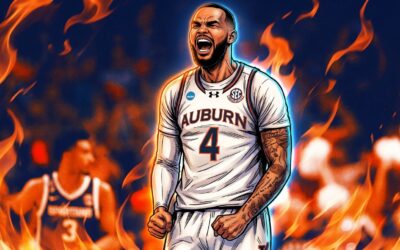
Kansas just couldn’t match. Not because the Jayhawks are broke, but because the number — reportedly around $5 million — was the kind of number that makes a college athletic department press pause and stare at the ceiling. So Flory Bidunga, the best center in the transfer portal and the Big 12 Defensive Player of the Year, is headed to Louisville, where Pat Kelsey apparently convinced someone to write a check that dwarfs what Bidunga would earn as a projected late first-rounder in the NBA.
Think about that for one second. CBS Sports reported that Bidunga is set to receive approximately $5 million to play for Louisville. The maximum Year 1 rookie salary for the 29th pick in the NBA Draft — right around where Bidunga was projected — is $2,763,960. College is paying him nearly double what the pros would. At that point you’re not choosing education over the draft. You’re choosing a better contract.
The NCAA spent fifty years building an entire moral mythology around the concept of the “student-athlete.” Not because it believed it, but because it was worth billions of dollars to say it with a straight face. The Supreme Court called the bluff in 2021. In NCAA v. Alston, nine justices — nine, unanimously — found that the NCAA’s compensation limits violated antitrust law. Justice Kavanaugh didn’t mince words in his concurrence: “The NCAA’s business model would be flatly illegal in almost any other industry in America.” Then the House settlement got approved in June 2025, requiring $2.8 billion in back damages and opening the door to $20.5 million per year in direct school-to-athlete revenue sharing. The fiction officially had an expiration date.
Bidunga isn’t a cautionary tale. He’s a 20-year-old from Kinshasa who came to the US at 15, worked his way through Kokomo, averaged 13.3 points, 9.0 rebounds, and 2.6 blocks per game this past season — the only Division I player to hit those thresholds simultaneously — and is now being compensated at a rate that reflects his actual market value. Good for him. Seriously. The outrage machine wants you to see this as a problem. It isn’t a problem. It’s a correction.
The “amateurism” model was never about protecting athletes. It was about extracting labor at below-market rates by calling it something else. An anonymous high-major coach complained to CBS Sports that “the guys aren’t worth the money they’re going for.” That same coach is probably sitting on a $4 million salary himself, in a program that generates $80 million a year. The nerve.
An anonymous agent summed up Louisville’s approach to 247Sports simply: Kelsey is “throwing the bag at everyone.” College basketball NIL spending has grown from an estimated $314.4 million in year one of the NIL era to an estimated $932.5 million this season. Kansas was paying Bidunga around $1 million annually. Louisville came in at five times that. This is how free markets work — the thing the NCAA always claimed to believe in, right up until it was workers doing the believing.
BREAKING: Kansas transfer Flory Bidunga and Oregon transfer Jackson Shelstad have committed to Louisville, @JoeTipton reports.
Bidunga ranks No. 1, and Shelstad No. 17 in the On3 Industry Transfer Portal rankings.https://t.co/mzMe9luCgH pic.twitter.com/nxNhooLCPF
— On3 (@On3) April 12, 2026
And here’s the thing nobody wants to say out loud: college basketball is more honest right now than it has ever been. Every season of the pre-NIL era was built on the premise that players were amateurs receiving an education as fair compensation for generating hundreds of millions in revenue. That was the lie. AJ Dybantsa’s reported $7 million deal at BYU wasn’t the moment things got weird. Bidunga’s reported $5 million at Louisville isn’t the moment things got weird. Those are the moments things got accurate.
The product is still good. The games are still real. The players are still competing. They’re just getting paid now. If your enjoyment of college basketball was contingent on the players not getting their cut, that says more about you than it does about them.