The House v. NCAA settlement was sold as the most significant reform in the history of college athletics: schools would share revenue directly with athletes, capped at $20.5 million annually, spreading the wealth across all sports. That was the story. The cap exists on paper and almost nowhere else. The people who wrote the rules have spent the better part of a year winking at the workarounds, or pretending they can’t see them.
This is college sports analysis in 2026: a system that promised equity and delivered a loophole big enough to route a Learfield contract through.
The Cap Was Never a Cap
The settlement took effect July 1, 2025. Within months, 319 of roughly 390 Division I schools had opted in, 82% of the field. The NCAA celebrated it as a mandate. The $20.5 million figure was presented as a firm ceiling. Conferences issued compliance guidelines. The College Sports Commission stood up as the enforcement body. Everyone performed seriousness.
Then Texas started spending $50 million on roster construction.
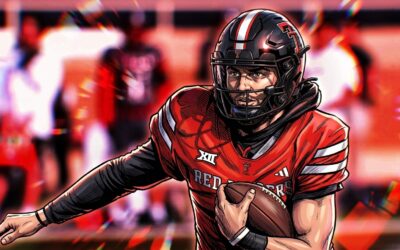
How? The “associated entities” loophole. Multimedia rights partners like Learfield and Playfly, apparel brands like Nike and Adidas, and corporate sponsors can redirect money into above-cap NIL deals, at the school’s direction, with the school’s blessing, and often with the school’s fingerprints carefully removed. Nebraska had 18 football players carrying $7 million-plus in NIL contracts through Playfly in spring 2026. Texas Tech ran a $28 million football roster, including $7 million on the defensive line alone.
Pete Bevacqua, Notre Dame’s athletic director, said it plainly: “The numbers you’re hearing and the numbers we know that are out there don’t compute with the cap number.”
Bryan Seeley, the CSC’s own CEO, told Sportico that schools were responding to oversight requests with “false responses.” The College Sports Commission has approved nearly $300 million in third-party NIL deals, with $200 million more under review or rejected. And the College Sports Commission has proven it can’t enforce anything. A federal magistrate ruled in June that multimedia rights companies can be subject to CSC oversight. This was treated as a breakthrough. That’s how far enforcement has gotten.
Dave Doeren, NC State’s head coach, put it this way: “It certainly seems like loopholes have won the day and I don’t know what’s real or what isn’t real anymore.” He is correct.
Arch Manning Gets Paid. The Swimmer Doesn’t.
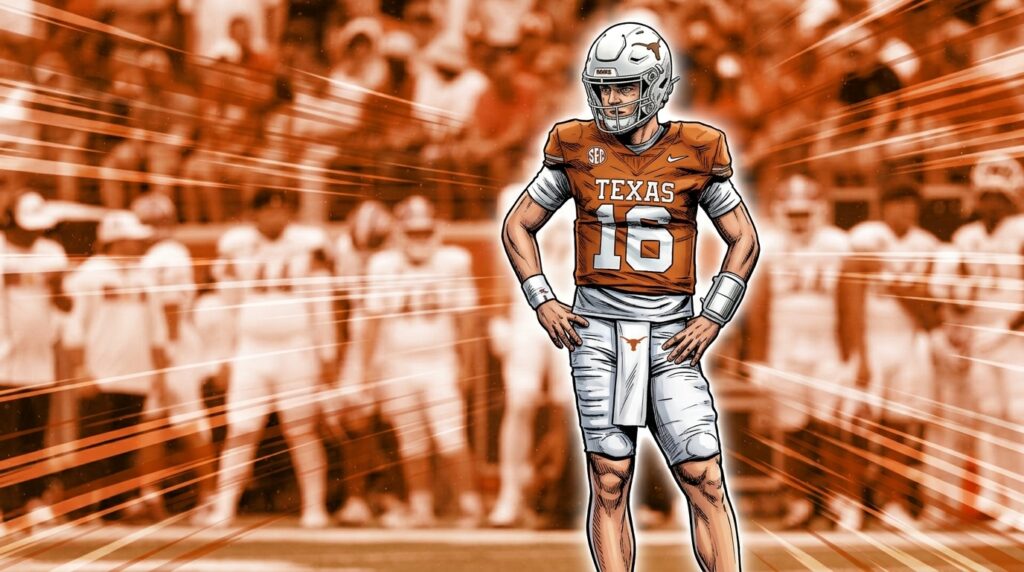
Arch Manning’s On3 NIL valuation sits at $5.4 million — the highest of any current college athlete. He has deals with Adidas, Red Bull, Google Gemini, EA Sports College Football (NIL deal), Nintendo, American Eagle, 7-Eleven, and Lululemon. Jeremiah Smith, Ohio State’s wide receiver, is valued at $4.2 million and reportedly turned down a transfer offer worth “over $10 million, easy.” Michael Lombardi, UNC’s athletics GM, has stopped pretending otherwise. “Let’s make no doubt about it: We’re in a professional era.”
Fine. The professional era has a mean NIL earning figure of $28,400 across Division I athletes; the median is far, far lower. Most athletes earn nothing at all.
Texas Tech sends 74% of its revenue-sharing pool to football, 17-18% to basketball. That leaves roughly 8% split among every other sport on campus: the wrestling team, the volleyball team, the cross-country program, the swimmers. The swimmers who helped Texas Tech meet Title IX minimums while the school built a permanent caste system in which their labor funds someone else’s quarterback deal. That’s not hyperbole. That’s arithmetic.
Congress Has a Bill. It’s Moving at Congress Speed.
The Protect College Sports Act, sponsored by Ted Cruz and Maria Cantwell with Schmitt and Coons, passed the Senate Commerce Committee 19-9 on June 18. That’s the furthest any college sports reform bill has ever gotten in Congress. It’s also the lowest possible bar.
Cruz is targeting a July floor vote, and the bill needs 60 votes to clear cloture. The SEC and Big Ten are fighting a media-pooling provision that would spread broadcast revenue downward. So the two conferences that extracted the most money from the current arrangement are the ones most aggressively lobbying against the reform. Nothing about this should surprise anyone.
President Trump is exactly right.
College sports are at a breaking point. The chaos must end. Our bill, the Protect College Sports Act, establishes clear national rules for college athletics, protects student-athletes, and preserves the historic rivalries that make college… https://t.co/qV69oT3uw8
— Senator Ted Cruz (@SenTedCruz) June 4, 2026
Cantwell put it this way after the committee vote: “What we did today was say we’re not going to let the most powerful, richest conferences dictate to the rest of America what’s going to happen to 500,000 athletes.” That’s a correct statement. Getting to 60 before the loophole swallows another recruiting cycle is a harder question, and Congress’s track record on harder questions is not encouraging.
This wave of change is expected to be only the first of adjustments to the CSC system. Power league commissioners are also discussing increasing the revenue-share cap in an effort to match the market.
More on that here – https://t.co/4m4lTFDrem
— Ross Dellenger (@RossDellenger) June 23, 2026
The Protect College Sports Act Won’t Fix This Either
What the PCSA doesn’t do: it doesn’t mandate equitable distribution across sports. It codifies revenue sharing and adds some guardrails around the associated-entities loophole, but schools retain discretion over how the pool gets divided. Texas Tech can still send 74% to football under any version of this bill that has a chance of passing.
The gymnast at a mid-major — one who doesn’t generate revenue, whose program exists partly to satisfy federal law — gets whatever’s left after the football staff divides the pool. Probably not much. Probably nothing above the base revenue share, if her school opted in at all.
Cody Campbell, the Texas Tech booster who personally bankrolled that $28 million football roster, celebrated the committee passage on social media.
Let’s go!! This is a huge step forward and a great day for College Sports! Thank you to @tedcruz @SenatorCantwell @Eric_Schmitt @ChrisCoons and everyone who worked so hard to get the first ever viable college sports bill negotiated and through committee! https://t.co/pHOgtOP6s8
— Cody Campbell (@CodyC64) June 18, 2026
That’s the tell. The people who weaponized the loophole are cheering the reform bill because they’ve already won. The cap will get adjusted upward, the loopholes will get laundered into official policy, and Arch Manning will sign another deal with someone who sells energy drinks. The swimmer will keep swimming.