Michigan beat Western Michigan 13-12 on a Hail Mary, and the play only existed because officials found a second that the broadcast graphic had already spent. That’s the whole controversy. Everything since has been the Big Ten trying to explain it, badly.
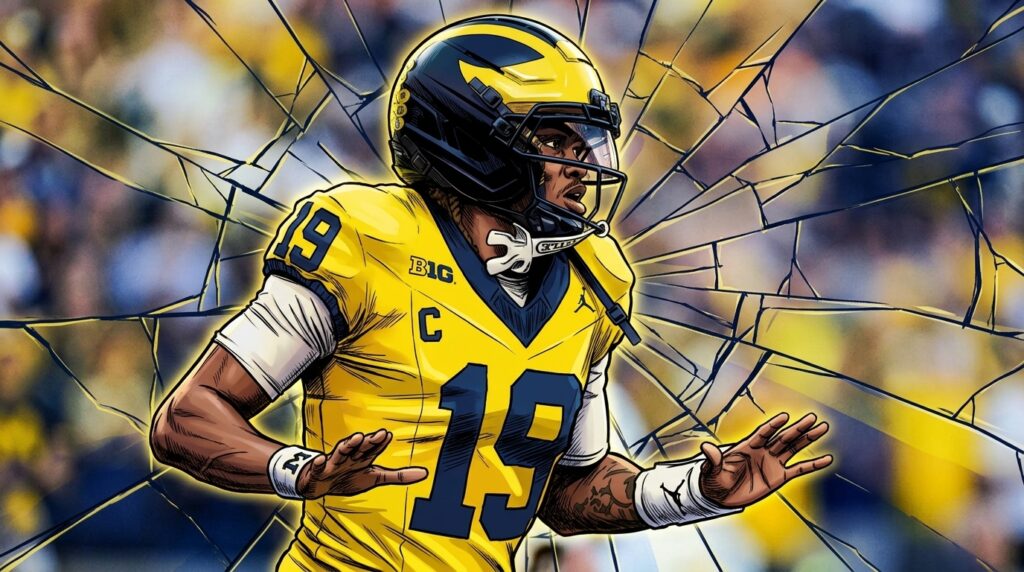
Nothing about the sequence itself is in dispute. Bryce Underwood’s first Hail Mary of the night sailed incomplete while NBC’s clock graphic read 0:00, and Western Michigan started celebrating a signature upset over a ranked opponent. Then the league’s replay center reviewed the play, restored one second to the clock, and sent Michigan back out for another try. Underwood found JJ Buchanan for a 47-yard touchdown, and the Wolverines walked away 13-12 winners that almost nobody outside Ann Arbor believes they deserved.
The Big Ten’s official explanation says video review showed Western Michigan’s No. 18 jumping from out of bounds and making contact with the ball while one second still showed. That’s on a stadium clock, though, not the one on your television. NBC put out its own statement noting that its broadcast clock “is not the official arbiter” of game time. A fine legal point to make after your own graphic told everyone the game was over.
That distinction might even hold up on paper. It just didn’t hold up with the two people whose entire job is explaining replay decisions on live television.
NBC rules analyst Terry McAuley said as much in real time, before anyone had a chance to spin it. “The ball isn’t even close to touching a player when it goes to zero,” McAuley said during the broadcast. “Their Hawkeye system, apparently, either had a different sync or whatever, and they came up with one second when it touched the player. I don’t see how that happened.” He put it more bluntly later: the ball was “clearly still in the air when the clock goes to zero.”
Mike Pereira, who used to run NFL officiating, spent an entire segment on the Joel Klatt Show picking apart the process instead of the result. “It’s the right call with what they were looking at, but it’s wrong,” Pereira said. “They didn’t follow the protocol, which, by the way, is not in the rule book.” His read on that protocol: when there’s a discrepancy between the replay center’s own camera and what the broadcast shows everyone else, “you use the footage that everybody sees.” Same standard in the NFL, he said, and the UFL. The Big Ten’s officials watched their own feed and skipped the one running on national television.
None of this is a MAC-versus-Big-Ten grudge match, and it’s worth saying plainly: MAC commissioner Jon Steinbrecher accepted the explanation without a fight. If anyone had standing to be furious about this and wasn’t, it was him. The skepticism isn’t coming from a conference protecting its interests. It’s coming from a former NFL replay czar and an on-air rules analyst with no rooting interest in either team.
Fans noticed the same gap between “technically defensible” and “actually convincing.” Robert Griffin III put it to his followers directly:
Dear football fans, this is a safe space.
How do you feel about the refs putting 1 second back on the clock after it look like Western Michigan had upset Michigan by knocking down the 1st Hail Mary?
Michigan ending up winning on a Hail Mary on the next play. pic.twitter.com/KDmwHYTa6E
— Robert Griffin III (@RGIII) September 6, 2026
Nobody needed RGIII’s blessing, but it says something that a former quarterback with zero stake in this game felt compelled to poll the timeline about it. Dan Orlovsky went further on Pat McAfee’s show, calling it “probably the most embarrassing win I’ve ever seen in college football” — and he was describing a 16th-ranked blue blood beating a MAC team by one point, not a backyard scrimmage.
Michigan is 2-0, and the record book doesn’t care how a win happened. But a conference office just watched its own hired rules analyst call the explanation into doubt, live, before the ink on the statement had dried. Not a scandal — just not the kind of confidence a league wants broadcast to the entire country, and pretending otherwise is its own small embarrassment.