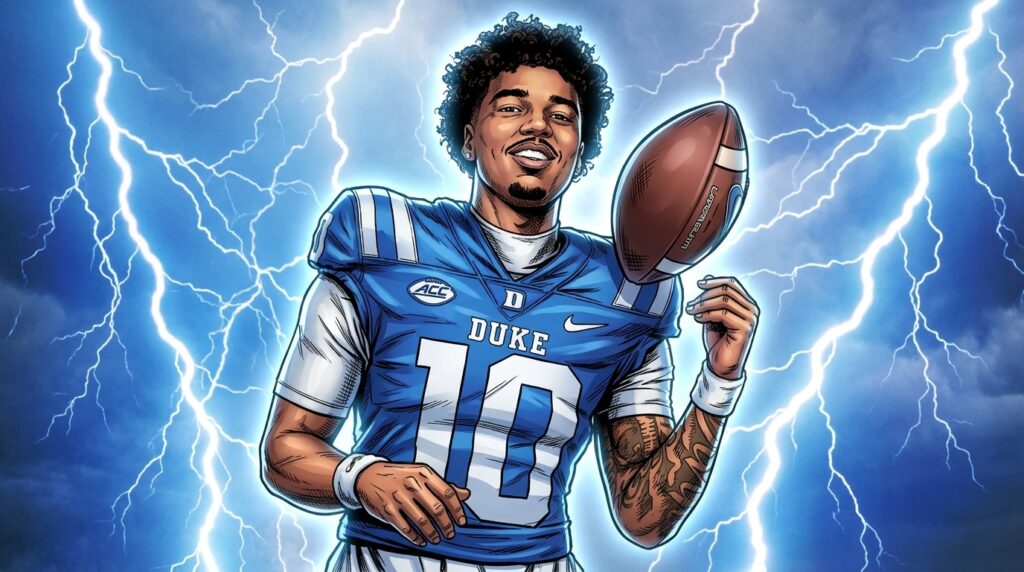
When Darian Mensah stood in front of reporters at ACC Kickoff in Charlotte on July 15 and said “business is business,” the room got a little uncomfortable. A 21-year-old quarterback just said the most honest thing anyone in college football has said in public in years, and somehow that was the scandalous part.
The facts of his arc are by now well known, but they bear repeating for the record. Mensah came out of Tulane, a program that developed him from a raw recruit into a legitimate Power conference starter, and signed with Duke for a reported $8 million over two years. He proceeded to be excellent. In 2025 he threw for 3,973 yards and 34 touchdowns, led Duke to its first ACC title since 1962. On December 19, he posted to Instagram that he was coming back. On January 16, the last day of the transfer portal window, he entered the portal.
Duke did not respond with a press release about wishing him well. Duke sued him in civil court. Not in NCAA proceedings, not through athletic department mediation. In actual civil court, alleging breach of contract and seeking an injunction that prevented Mensah from enrolling at Miami while the court weighed the request. A non-profit university, enforcing what functioned as an employment contract, against a person the NCAA had spent sixty years insisting was not an employee. The case moved quickly. Within about a week, before the injunction hearing was even held, the parties settled. Mensah signed with Miami. He is now the No. 1 NIL valuation in college football per On3, at a reported $6.5 million annually, and reportedly paid Duke in installments to buy out his contract, money that went back to the university that had just tried to hold him in place via civil court.
The takeaway everyone wanted to argue about was a three-word phrase in Charlotte.
Ross Dellenger of Sports Illustrated laid out exactly what Duke was trying to enforce:
QB Darian Mensah is in the second year of a 2-year deal with Duke at $4M annually. Per @flasportsbuzz, he is expected to sign with Miami.
Like most rev-share contracts, Duke's deal prohibits another university from using Mensah's NIL – a legal entanglement that must be resolved. https://t.co/khOKJ035wR
— Ross Dellenger (@RossDellenger) January 16, 2026
A school suing a non-employee under contract law to enforce a deal for athletic services.
The NCAA’s House settlement received final court approval in June 2025, formally authorizing schools to share revenue directly with athletes starting that summer. That date is about as close to an official death certificate for amateur athletics as you’re going to get. The whole apparatus — the grant-in-aid model, the “student-athlete” designation, the righteous invocations of competitive balance and educational mission — collapsed into what it had always actually been: a labor system in which the people generating the revenue had the least control over their own professional futures. The settlement didn’t change the underlying logic. It just stopped pretending the logic was something else.
Duke’s lawsuit made that undeniable. You cannot simultaneously claim that players are not employees and then drag one into civil court to enforce the financial terms of an agreement that was, in every meaningful respect, a contract for services. The “student-athlete” fiction required maintaining the pretense that these arrangements were something other than employment. Once you file a breach-of-contract suit, you’ve abandoned that pretense in the only place it actually matters — before a judge. Duke’s lawyers presumably did not argue in those filings that Mensah was a beloved young man pursuing his education. They argued he owed them money.
There is something almost clarifying about this. College football has spent decades insisting it exists outside the normal rules of labor economics, and for a long time, through amateurism rules, NCAA enforcement, and the coordinated legal resistance of institutions with vast resources and sophisticated counsel, it sort of did. And then those days ended. Mensah’s trajectory from Tulane to Duke to Miami is the clean evidence. The AAC developed him. The ACC money acquired him. A civil lawsuit tried to keep him in place. A bigger ACC check won. That’s not a scandal. That’s a market.
The discomfort in Charlotte wasn’t really about Mensah’s candor. It was about what his candor made visible. “Business is business” isn’t controversial — it’s accurate. It describes exactly what happened, from every party’s behavior. Duke offered an eight-figure deal to buy his services. Mensah accepted. Duke sued to enforce the deal when he left. Mensah settled for terms that presumably reflected his actual leverage. Miami offered more. He signed. Every institution in that sequence behaved exactly like a business.
The only people still pretending otherwise are the ones who need the pretense to survive — the ones whose tax exemptions, Title IX calculations, and Congressional relationships depend on the fiction that this is education, not industry. Mensah just didn’t feel like maintaining that fiction for a media availability in Charlotte. Can’t really blame him.