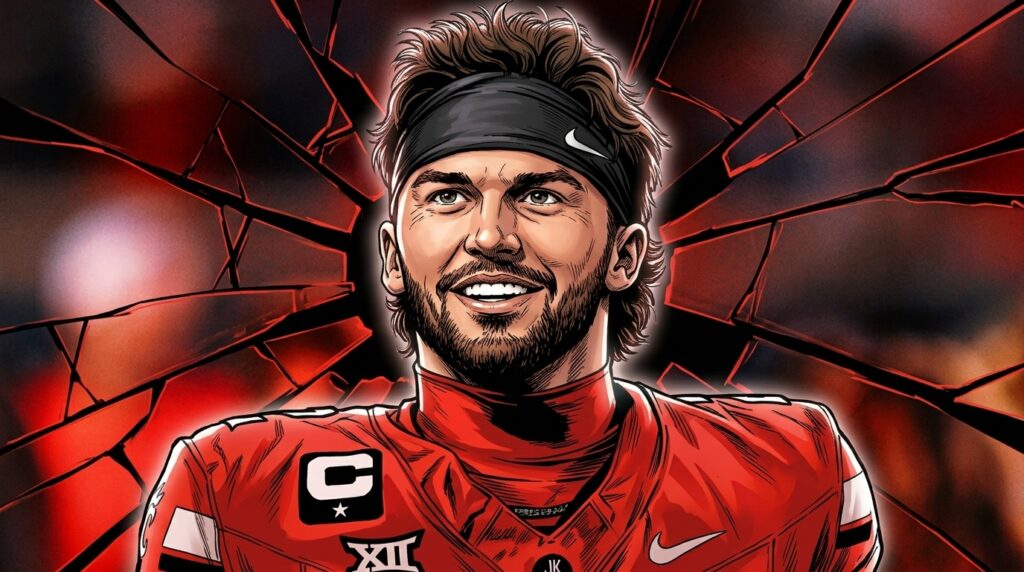
Joey McGuire is at the podium in Frisco today, answering questions about Big 12 Media Days while a federal lawsuit with his school’s name on it sits unresolved in the Northern District of Texas. Brendan Sorsby is gone — cut loose after the NFL declined his supplemental draft application and the CFL passed on him too. But the conference filed 47 pages of legal argument at 1 AM on June 15, and nobody’s dismissed it.
That’s not an accident. That’s the story.
A Local Judge Overruled an Entire Governing Body
Retired judge Ken Curry issued a preliminary injunction on June 8 that did something genuinely extraordinary. It compelled the NCAA and the Big 12 to accept an ineligible player onto a member institution’s roster. Not “declared the penalty too harsh.” Not “suggested the process was flawed.” Ordered the sport’s governing body to look the other way while a player who placed more than 10,000 bets totaling roughly $90,000 — including approximately 40 on Indiana football games while he was on Indiana’s roster — suited up for a $6 million NIL deal.
The NCAA’s permanent ineligibility ruling wasn’t controversial given the facts. Sorsby used family and friends’ accounts to disguise the activity over four years. The violation was systematic, not a one-time lapse in judgment. The penalty matched the conduct.
None of that mattered to Judge Curry.
Texas Tech Bought a Problem It Couldn’t Control
Texas Tech promised Sorsby $6 million and got six months of chaos. Georgia and Nebraska immediately boycotted all athletic scheduling with the program. Michigan canceled a volleyball match. The Big Ten held internal discussions about a conference-wide ban. Cincinnati — Sorsby’s previous school — filed a separate lawsuit seeking $1 million in exit fees.
And now Texas Tech is sitting on $6 million in NIL payments it cannot recover, legal bills from a federal lawsuit it helped create, and a quarterback who never threw a pass for them.
Barry Odom, the UNLV coach and former Missouri head coach, put it plainly: “The fact is, if Texas Tech had it to do over again, they’re not recruiting Brendan Sorsby, and this doesn’t happen.” That’s probably accurate. It’s also completely beside the point.
The incentive structure that made this feel reasonable — $6M, a proven quarterback, a local judge who might help — hasn’t changed. The next program facing a similar situation will face the same calculus.
The Conference Isn’t Done
The Big 12 filed its federal complaint arguing it had the right to sanction Texas Tech under its own bylaws. That’s it. No damages sought. Just the right to enforce its own rules against a member who used the courts to circumvent them. Conference ADs are still — as of today, while Brett Yormark opens Media Days in Frisco — debating whether Texas Tech should pay the legal fees.
The NCAA said it clearly: “No institution should face a court order compelling it to grant eligibility to an ineligible student-athlete.” That’s not spin. That’s a description of a structural collapse. A local judge in Lubbock, Texas briefly had more authority over college football eligibility than the organization that runs the sport.
Every other conference AD in the country watched that happen and started wondering which state they play in and which judges sit in those districts.
What the Courts Inherit
Sorsby will be eligible for the 2027 NFL Draft after settling with the NFL and NFLPA. He sits out all of 2026. The system he exploited — transfer portal, NIL, eligibility appeals, state court injunctions — functioned exactly as designed. He found every lever available and pulled them. Texas Tech pulled theirs. A retired judge pulled his.
The sport built this machine over the last decade, piece by piece, every time a conference needed a competitive edge or a school needed a loophole or an athlete needed a workaround. Congress tried to fix the underlying NIL framework and couldn’t. What’s remarkable about Sorsby isn’t that he tried it. It’s that it almost worked.
The only thing that stopped it was a 1 AM federal filing and a player who couldn’t get an NFL roster spot.
The lawsuit outlived the player. The courts are cleaning up what the sport couldn’t govern.
This moment is when you realize other nations aren’t built for this.
The Big 12 had a federal lawsuit ready in like 20 minutes to keep Brendan Sorsby from playing college football.
Belgium doesn’t have the balls to do more than send whiny press release. #USMNT https://t.co/bZOOXSNOPG
— CHIEF, THE (@WarPigsChief) July 5, 2026